An Aluminium Entrance Door combines a lightweight metal frame with a practical barrier between outdoor weather and indoor life. It often features thermal breaks, insulated panels, multipoint locks, and durable powder-coated finishes. In real homes, that can mean a stable doorway, smoother daily operation, and less visible wear around the handle and threshold.
The International Energy Agency reports that buildings consume about 30% of global final energy. Its Buildings 2023 analysis also links building performance with stronger efficiency measures. A properly designed Aluminium Entrance Door can support this goal when its frame, glazing, seals, and installation work together. The U.S. Department of Energy’s Energy Saver guidance highlights low-emissivity glazing, weatherstripping, and careful air sealing as important efficiency measures. The door material alone is not enough. That distinction matters.
Aluminium also offers a useful durability story. The International Aluminium Institute states that aluminium can be recycled repeatedly without losing its essential properties. This supports circular design, although recycling outcomes depend on collection systems and local processing. Standards such as EN 14351-1 and ISO 10077-1 help professionals assess performance, including air permeability, water tightness, and thermal transmission. Still, product data can look better than installation reality. A poorly fitted door may admit drafts, collect water, or weaken security. Reliable selection therefore requires verified test results, qualified installers, and a climate-appropriate specification. The best entrance door is not simply modern-looking. It should feel solid under the hand, close cleanly, and perform quietly through changing seasons.
What Is an Aluminium Entrance Door?
What Is an Aluminium Entrance Door?
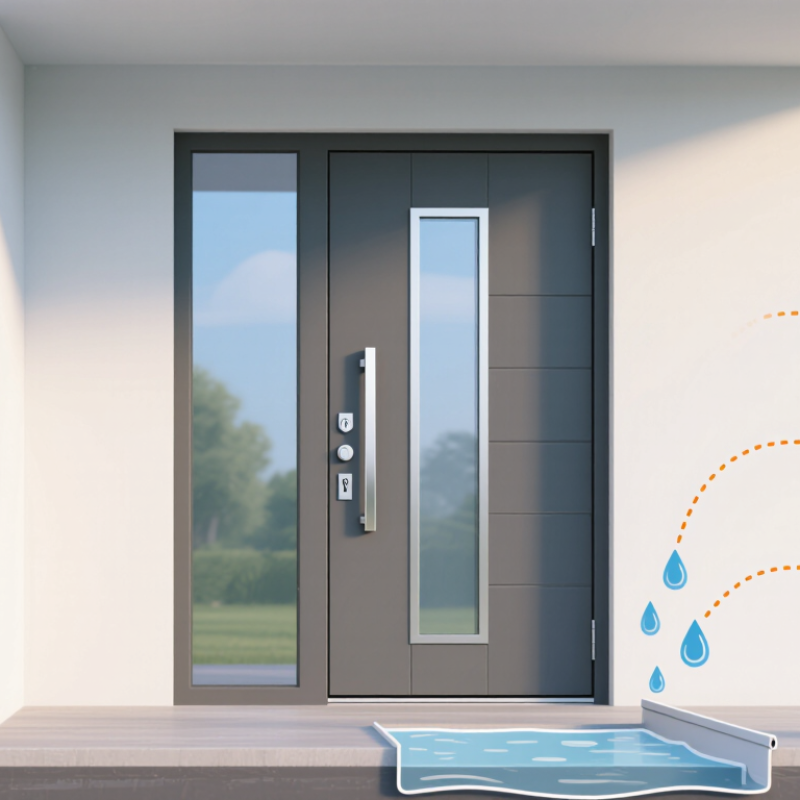
An aluminium entrance door is an exterior door made from lightweight aluminium profiles, panels, glass, seals, and hardware. Its frame usually contains a thermal break, which separates the inner and outer metal sections. This detail reduces heat transfer through the frame. Without it, aluminium can conduct outdoor cold or summer heat too easily.
The door is engineered for daily contact with weather and people. Powder-coated or anodised surfaces resist fading, corrosion, and peeling when properly maintained. The aluminium frame also stays relatively stable during temperature changes. That matters when a door must close tightly after years of opening and locking. However, aluminium alone does not guarantee energy efficiency. Glass type, panel insulation, weather seals, installation quality, and threshold design matter just as much.
The International Energy Agency reports that buildings consume about 30% of global final energy. A well-installed entrance door cannot solve that problem alone. It can, however, reduce drafts and unwanted heat exchange at a vulnerable opening. The U.S. Department of Energy recommends checking a door’s U-factor, where a lower value indicates better insulation. In practical terms, look for a firm seal, a warm-edge threshold, and smooth closing action. Small gaps are easy to overlook. They are often where comfort is lost.
What Is an Aluminium Entrance Door and What Are Its Benefits?
| Dimension | Key Fact or Typical Value | Explanation and Practical Benefit |
|---|---|---|
| Definition | Door system made primarily from aluminium profiles | An aluminium entrance door uses extruded aluminium frames, panels, glazing, hinges, seals, and locking hardware to create a main external entrance. The frame may include a thermal break to reduce heat transfer. |
| Material density | Approximately 2.70 g/cm³ | Aluminium is substantially lighter than many traditional metals while still providing a strong structural frame. Lower weight can make large door leaves easier to operate when the hardware is correctly specified. |
| Strength-to-weight performance | High for a lightweight frame material | Aluminium profiles can be engineered with internal chambers and reinforced sections. This supports wide openings, large glazed areas, and slim sightlines without relying on a heavy solid frame. |
| Thermal insulation | Thermally broken systems can achieve low U-values | A typical thermally broken glazed entrance-door system may achieve an overall U-value of approximately 1.0–2.0 W/m²K, depending on the profile, glazing, panel, seals, size, and installation. Lower U-values indicate better insulation. |
| Thermal conductivity | About 205 W/m·K for common unalloyed aluminium | Aluminium itself conducts heat efficiently, so a thermal break, insulated panels, multi-chamber profiles, and continuous weather seals are important for improving the door’s energy performance. |
| Weather resistance | Strong resistance to moisture and corrosion when properly finished | Powder coating or anodising helps protect the surface from weather exposure. Correct drainage, gaskets, thresholds, and installation details are still necessary to control rain penetration and air leakage. |
| Maintenance requirement | Generally low maintenance | Aluminium does not rot, warp, or rust in the same way as untreated steel or timber. Routine cleaning, inspection of seals, and periodic lubrication or adjustment of moving hardware are normally required. |
| Design flexibility | Available in many colours, finishes, panels, and glazing configurations | Aluminium can be finished in a broad range of powder-coated or anodised colours. It can also accommodate clear, tinted, laminated, or double-glazed units, subject to the door system and safety requirements. |
| Security potential | High when designed and tested as a complete door set | Security depends on the complete assembly, including the frame, hinges, cylinder, multipoint lock, laminated glazing, panels, and installation. A strong aluminium profile alone does not determine the security level. |
| Acoustic performance | Depends mainly on glazing, panels, seals, and installation | Laminated or insulated glazing and effective perimeter seals can reduce external noise. The final sound-reduction performance should be based on tested values for the complete door assembly. |
| Fire performance | Not automatically fire-resistant | Standard aluminium entrance doors are not necessarily fire-rated. Where fire resistance is required, the complete door set must use a tested and certified fire-rated design with compatible hardware and installation. |
| Dimensional stability | Good resistance to rot and moisture-related deformation | Aluminium is not a hygroscopic material, so it does not absorb moisture and swell like timber. Its thermal expansion must still be considered when designing large frames and allowing suitable installation tolerances. |
| Sustainability | Aluminium can be recycled repeatedly without losing its basic material properties | Recycling aluminium generally requires far less energy than producing primary aluminium from ore. The environmental impact also depends on the recycled content, manufacturing process, transport, service life, and end-of-life recycling route. |
| Expected service life | Often several decades with suitable specification and care | Long service life depends on coating quality, exposure conditions, drainage, hardware durability, cleaning, and installation. Moving components may require replacement or adjustment before the main frame reaches the end of its service life. |
| Best suited applications | Homes, apartments, offices, retail units, and public buildings | Aluminium entrance doors are suitable where slim profiles, weather resistance, low maintenance, large glazing areas, and modern design flexibility are important considerations. |
Note: Performance figures are typical reference values only. Actual results depend on the complete door system, dimensions, glazing, hardware, local climate, installation quality, and applicable building regulations.
FAQS
Design begins with the measured opening, not a catalogue size. Installers check wall thickness, floor levels, wind exposure, and daily traffic. Small gaps matter.
The door combines aluminium profiles, glass panels, seals, hinges, thresholds, and locking hardware. Internal chambers strengthen the frame. Thermal breaks help separate indoor and outdoor metal sections.
Polyamide strips can reduce heat transfer through the aluminium frame. Insulated glass and compression seals may further reduce draughts. Results depend on accurate fitting.
Aluminium usually resists swelling, cracking, and twisting during temperature changes. A coated surface can handle rain, sunlight, and everyday impacts. It is not indestructible.
They usually need less maintenance than painted timber doors. Mild soap and water can clean the surface. Blocked drainage channels, scratches, and loose hardware still need attention.
Security depends on the complete door system, not the frame alone. Strong hinges, suitable locks, laminated glass, and correctly fitted seals all contribute. Hardware selection deserves careful thought.
Thermal breaks, insulated glazing, and well-fitted gaskets can reduce heat loss. The entrance may feel warmer in winter and cooler in summer. Poor installation can cancel these benefits.
The frame should be fixed to sound masonry and checked for plumb. Installers should test opening, closing, locking, drainage, and threshold alignment several times. It must fit.
A low threshold can improve accessibility and create a smoother floor transition. It still needs effective drainage and accurate floor detailing. Water management is easy to underestimate.
A door may look precise but operate poorly. Misaligned frames can cause difficult locking, noise, draughts, or water entry. Adjustment after installation deserves more attention.
Conclusion
An Aluminium Entrance Door is a modern entry solution made from strong, lightweight aluminium profiles and insulated glass or solid panels. It is carefully designed and constructed with reinforced frames, secure locking systems, weather-resistant finishes, and thermal-break technology to improve stability and energy efficiency. Available in many styles, these doors may feature single or double panels, glazed or solid surfaces, sliding or hinged operation, and a wide range of colours and finishes to suit different architectural designs.
The main benefits of an Aluminium Entrance Door include excellent durability, resistance to rust and warping, low maintenance requirements, strong security, and reliable protection against changing weather conditions. Its slim frames can also allow more natural light into a building while maintaining structural strength. When choosing one, consider the door’s size, insulation performance, security features, opening style, finish, and compatibility with the surrounding structure. Regular cleaning, checking seals and hinges, and maintaining the locking hardware will help preserve its appearance and performance for many years.