Modern aluminum entry doors are changing how architects and homeowners define security, light, and curb appeal. This shift is especially visible in China, where advanced extrusion, thermal-break, and powder-coating technologies support increasingly demanding residential projects. China is not only a manufacturing base. It is also a testing ground for slimmer frames, oversized glass panels, concealed hinges, and smart access systems.
Industry data supports this momentum. The International Aluminium Institute reports that building and construction remain among the largest global applications for aluminum. Grand View Research also identifies doors and windows as a significant segment within the broader aluminum building-products market. These findings suggest durable demand for aluminum systems, although market reports often combine doors, windows, and curtain walls. That limitation matters.
Performance comes first.
For buyers comparing China’s top 10 manufacturers, product photographs are not enough. A reliable evaluation should examine alloy grades, profile-wall consistency, thermal transmittance, water penetration, air leakage, hardware cycles, and coating performance. Factory experience also matters when projects involve coastal humidity, intense sunlight, or irregular openings. Certifications should be verified through current laboratory documents, not copied brochure claims.
This guide reviews leading Chinese manufacturers of Modern Aluminum Entry Door systems through a practical lens. It considers design capability, customization, production control, export experience, testing evidence, and after-sales support. Rankings can never be completely objective. A supplier strong in luxury villas may not suit high-volume apartment projects. Still, careful comparison can reduce costly surprises, from misaligned thresholds to fading finishes. The best choice balances visual precision with measurable performance.
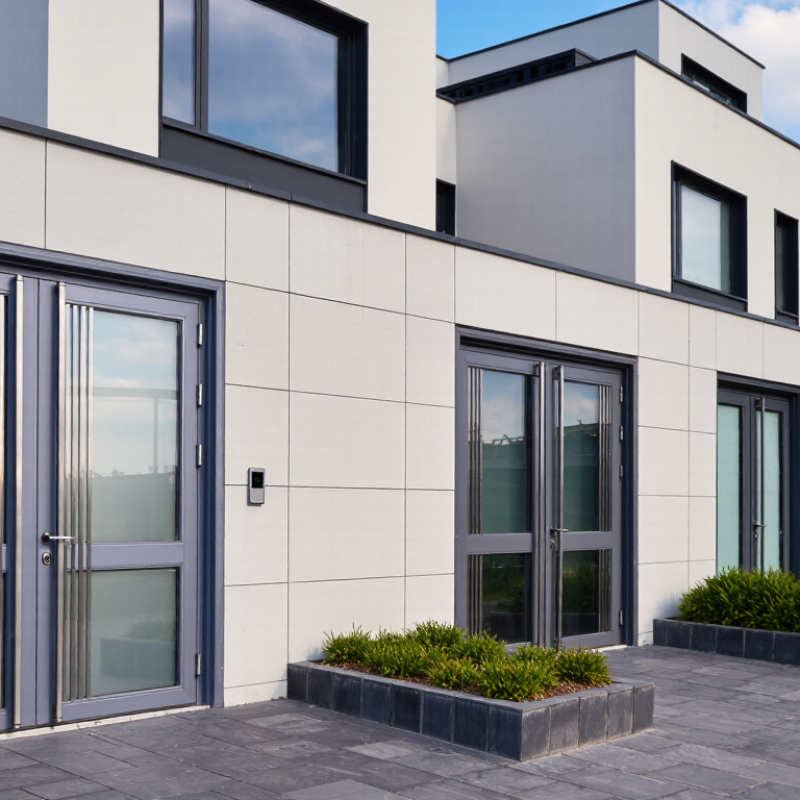
Modern aluminum entry doors are exterior doors made with engineered aluminum frames, insulated panels, glass, hardware, and weather seals. Their purpose extends beyond creating a first impression. They control access, daylight, airflow, security, and thermal comfort at the building entrance.
Aluminum offers a strong structure with relatively low weight. Its resistance to corrosion also supports long-term outdoor use, especially when the surface receives suitable protective treatment. In practice, a well-designed door should open smoothly, close firmly, and remain stable through changing temperatures. Thermal breaks reduce heat transfer through the frame, while multi-point locks can improve security when correctly installed.
Details matter greatly.
Professional buyers should review frame thickness, glass performance, drainage design, seal quality, and hardware cycles. Factory inspection records and installation guidance provide stronger evidence than attractive product images. Site conditions also influence the result. A coastal building may need different surface protection than an inland project. Large glass panels can brighten an entrance, but they may increase heat gain without proper glazing selection.
A polished specification is not always a complete solution. Poor installation can cause air leakage, water entry, or uneven gaps, even when the door itself is well made. Measurements should be checked twice, and maintenance access should be considered before ordering. The best modern aluminum entry door balances appearance, structural performance, climate response, and daily usability rather than chasing style alone.
China’s leading aluminum door manufacturers combine precise engineering with practical customization. They commonly use 6063-T5 or 6061 aluminum profiles for strength and dimensional stability. Thermal-break systems reduce heat transfer through insulated polyamide strips. This feature matters in both hot and cold climates. Quality factories also use powder coating or anodizing for surface protection. Finishes should resist fading, peeling, and coastal humidity. Details matter.
Experienced manufacturers offer several opening styles, including hinged, sliding, pivot, and oversized entry doors. They adjust profile depth, glass thickness, hardware position, and threshold design to suit each project. Multi-point locks, adjustable hinges, concealed drainage, and laminated glass improve security and daily performance. Good suppliers explain these choices clearly. They do not simply promote attractive finishes.
Reliable production depends on more than modern machinery. Factory teams should inspect incoming profiles, cut lengths, welding points, corner joints, and coating thickness. Ask for evidence. Sample doors can reveal alignment problems that drawings hide. Independent testing may confirm air leakage, water resistance, wind pressure, and repeated opening cycles. Export experience also helps with packaging, installation guides, and replacement parts. However, catalog specifications are not always consistent with site results. Moisture, poor installation, or incorrect measurements can reduce performance. A careful buyer should review shop drawings, test reports, warranties, and local code requirements before approving production.
The top ten modern aluminum entry door manufacturers in China are selected through practical criteria, not attractive catalogs alone. A reliable manufacturer should offer stable alloy quality, accurate fabrication, durable finishes, and clear technical support. Modern designs often use slim frames, large glass panels, concealed hinges, and secure multi-point locks. These details create a clean entrance, but they also demand careful engineering.
In project evaluations, buyers should examine production equipment, quality inspection records, and completed installations. Factory visits can reveal more than product photographs. Check corner joints, drainage channels, sealant lines, and powder-coating consistency. Ask whether the manufacturer can provide thermal-performance data and installation drawings. A strong supplier also explains lead times honestly and responds clearly when measurements change. Some impressive doors still have weak threshold details. That is easy to miss.
Tips: Request a full-size sample corner before placing a large order. Test the handle, lock, seals, and opening movement. Confirm aluminum thickness, glass specification, surface treatment, warranty coverage, and replacement procedures in writing. Compare at least three factories using the same technical checklist. This makes pricing differences easier to understand. Do not judge quality by weight alone. A heavier door may still have poor alignment or unsuitable hardware.
China Top 10 Modern Aluminum Entry Door Manufacturers
China’s leading modern aluminum entry door manufacturers usually begin with controlled material selection. Many use 6063-T5 or 6063-T6 aluminum profiles for stable frames and clean machining. Thermal-break systems reduce heat transfer through the frame. They also support better indoor comfort.
Reliable factories should document profile thickness, alloy certificates, coating performance, and hardware testing. Look for production systems aligned with ISO 9001 practices and relevant door standards, such as EN 14351-1 or ASTM testing methods. Air leakage, water resistance, and wind-load results matter more than attractive catalog images. Ask for current test reports.
Customization extends beyond color. Buyers can specify matte black, bronze, wood-effect finishes, or anodized surfaces. Powder coating can provide consistent coverage on large panels. Glass choices may include double glazing, laminated glass, low-emissivity glass, or decorative textures. Door widths, pivot layouts, concealed hinges, locks, thresholds, and sidelights can also be adjusted.
Small details often expose weak manufacturing control. Uneven corner joints, loose seals, or inconsistent powder thickness create problems after installation. A factory sample may look excellent, yet production quality can vary. This deserves careful checking. Request a full-size sample, inspection photos, packaging details, and replacement procedures before ordering. Good communication helps, but measurable records build greater confidence.
| Rank | Representative Product Profile | Typical Aluminum Alloy & Temper | Manufacturing Standards | Thermal & Structural Construction | Glazing Options | Surface Finish | Customization Options |
|---|---|---|---|---|---|---|---|
| 01 | Thermal-Break Pivot Entry Door | 6063-T5/T6 extruded profiles; 6061 alloy may be used for reinforced pivot areas | Common references: GB/T 8478, EN 14351-1, ASTM E283, ASTM E331 | Polyamide thermal barrier; multi-chamber frame; concealed or heavy-duty pivot hardware | Double or triple insulating glass; laminated, low-E, tinted, frosted, or clear glass | Powder coating to architectural color ranges; anodized or wood-grain transfer finishes | Oversized leaf, concealed closer, smart lock preparation, custom panel, transom, and sidelight |
| 02 | Minimalist Flush Aluminum Door | 6063-T5 profiles with aluminum sheet or composite-faced door leaf | Common references: GB/T 8478, EN 14351-1, ISO 10077-1 | Insulated core; EPDM weather seals; multi-point locking; flush outer face | Single, double, or laminated safety glazing depending on design | Matt, satin, or textured powder coating; optional anodized appearance | Groove lines, vertical pulls, hidden frame, custom height, and matching fixed panels |
| 03 | Thermal-Break French Entry Door | 6063-T5/T6 frame and sash profiles; reinforced 6061 components where required | Common references: GB/T 8478, EN 14351-1, ASTM E283, ASTM E547 | Thermally separated frame; compression seals; adjustable hinges; multi-point lock | Insulating glass units, laminated safety glass, decorative bars, and obscure glass | AAMA-compliant powder-coating systems may be specified; anodizing also available | Inward or outward opening, unequal leaves, sidelights, transoms, and custom muntins |
| 04 | Contemporary Slatted Aluminum Door | 6063-T5 extruded frame with solid or hollow aluminum slats | Common references: GB/T 8478, EN 14351-1, ISO 7599 for anodized finishes | Insulated frame; ventilated decorative slats; concealed drainage and weather seals | Glazed, partially glazed, or solid insulated door-leaf configurations | Powder coating, anodizing, and wood-effect finishes for exterior applications | Slat spacing, orientation, panel layout, privacy screen, pull handle, and ventilation pattern |
| 05 | Aluminum and Glass Pivot Door | 6063-T5/T6 frame; 6061-T6 may be used for hardware reinforcement | Common references: EN 14351-1, ASTM E283, ASTM E330, ASTM E331 | Thermal-break frame; engineered pivot set; perimeter compression gasket | Tempered, laminated, low-E, or insulated laminated glass; typical safety glazing requirement | Exterior-grade powder coating or anodized finish with matching hardware | Glass tint, opaque interlayer, offset pivot, automatic closer, digital lock, and custom pull bar |
| 06 | Insulated Aluminum Panel Door | 6063-T5 profiles with insulated aluminum-faced leaf | Common references: GB/T 8478, EN 14351-1, ISO 10077-1 | Polyurethane or mineral-wool core; thermal-break frame; adjustable compression seals | Optional vision panel with double or laminated insulating glass | Powder coating, anodized finish, or wood-grain transfer coating | Embossed panels, grooves, decorative inlays, kick plates, and custom hardware preparation |
| 07 | Modern Arched Aluminum Entry Door | 6063-T5/T6 curved extrusion or segmented fabrication | Common references: GB/T 8478, EN 14351-1, ASTM E283 | Thermal-break curved frame; laminated or insulated curved glazing where specified | Flat laminated glass, insulated glass, or formed curved glass depending on radius | Powder coating or anodizing; color matching subject to finish sample approval | Arch radius, fanlight, radial muntins, custom jamb depth, and coordinated side panels |
| 08 | Security-Focused Aluminum Entry Door | 6063-T5 frame with reinforced aluminum leaf and steel hardware backing | Common references: GB/T 8478, EN 1627, EN 14351-1, ASTM F588 where specified | Multi-point locking; reinforced hinges; anti-pry seals; optional thermal break | Laminated security glass, insulated laminated glass, or small protected vision panels | High-durability powder coating or anodized finish for exterior exposure | Security cylinder, keypad or biometric lock preparation, restricted opening angle, and door viewer |
| 09 | Large-Format Aluminum Entry System | 6063-T5/T6 profiles with reinforced sections for large leaf dimensions | Common references: EN 14351-1, ASTM E283, ASTM E330, ASTM E331 | Thermal-break frame; heavy-duty hinges or pivot hardware; engineered drainage | Large laminated or insulating glass units subject to size, weight, and safety calculations | Powder coating, anodizing, or wood-effect finish with coordinated accessory color | Custom maximum dimensions, integrated sidelights, concealed frame, automatic operator, and pull handles |
| 10 | Smart-Home Compatible Aluminum Door | 6063-T5/T6 thermal-break profiles with reinforced lock stile | Common references: GB/T 8478, EN 14351-1, ASTM E283, applicable electrical and lock standards | Insulated frame; multi-point lock; concealed cable routing where required; weather seals | Double or triple insulating glass; laminated, low-E, privacy, or decorative glass | Powder coating, anodizing, and wood-grain finishes with corrosion-resistant hardware | Fingerprint, keypad, RFID, mechanical key override, door sensor, video intercom, and remote-access integration |
Note: The specifications above represent commonly available product configurations and industry standards for modern aluminum entry doors manufactured in China. Final performance ratings, dimensions, glazing thickness, hardware compatibility, and certification requirements should be confirmed through project drawings and product test reports.
Choosing an aluminum entry door manufacturer requires more than comparing online prices. Check the factory’s production experience, engineering team, and quality control process. Ask for project photos, material specifications, and test reports. A dependable supplier should explain aluminum alloy grades, thermal-break systems, glass options, and surface finishes clearly. Vague answers are warning signs.
Request a physical sample before placing a large order. Inspect corner joints, hinges, locks, seals, and powder coating under natural light. Test the door several times. It should close smoothly without scraping or excessive movement. Confirm wind-load performance, water resistance, warranty coverage, and replacement-part support. Factory audits can reveal storage problems, weak packaging, or inconsistent workmanship. A beautiful showroom can still hide production gaps.
Tips: Compare at least three suppliers. Verify certifications independently. Ask for a detailed quotation, not a single total price. Confirm lead times in writing. Discuss installation tolerances and after-sales communication early. Experienced buyers often overlook packaging, especially for oversized doors. That mistake can be expensive. I would also question unusually low prices; savings may reflect thinner profiles or cheaper hardware. No manufacturer is perfect, so evaluate how openly the team handles defects, delays, and design changes.
They use engineered aluminum frames, insulated panels, glass, hardware, and weather seals. Each part affects comfort and performance.
Aluminum provides structural strength without excessive weight. It also resists corrosion when properly protected and maintained.
Thermal breaks reduce heat transfer through the frame. Suitable glazing can also limit unwanted heat gain near sunny entrances.
Check frame thickness, glass performance, drainage channels, seal quality, and hardware durability. Factory records matter more than attractive images.
Large glass panels can add daylight and visual openness. However, unsuitable glazing may increase heat gain inside the building.
Poor installation can create air leakage, water entry, or uneven gaps. A high-quality door cannot fully correct inaccurate measurements.
Coastal buildings may need stronger surface protection because of moisture and salt exposure. The correct treatment depends on local conditions.
Use the same technical checklist for at least three factories. Compare aluminum thickness, glass details, finishes, warranties, lead times, and replacement procedures.
Yes. A full-size sample corner can reveal joint quality, drainage design, sealant lines, and coating consistency.
Not always. Weight alone does not prove alignment, hardware quality, or suitable engineering. That assumption deserves a second look.
This guide explores the definition and practical role of a Modern Aluminum Entry Door in contemporary residential and commercial architecture. It explains how these doors combine security, weather resistance, energy efficiency, visual appeal, and long-term durability, making them suitable for various building styles. The article also introduces the key qualities of leading Chinese aluminum door manufacturers, including advanced production equipment, strict quality control, skilled workmanship, and dependable project support.
It presents ten notable categories of modern aluminum entry door manufacturers in China while focusing on manufacturing standards, material selection, surface treatments, hardware, insulation, glazing, dimensions, colors, and customization options. Readers will also learn how to evaluate a reliable supplier by reviewing certifications, product testing, production capacity, customization experience, communication, delivery performance, warranty terms, and after-sales service. These considerations can help buyers make a practical and informed decision for residential, commercial, or architectural projects.