Choosing an Aluminum Entry Door is a practical decision for homeowners who value strength, clean design, and long service. Aluminum resists rust, moisture, and everyday impact better than many traditional materials. It also supports slim frames, larger glass panels, and brighter interior spaces. That visual openness can change a dark hallway completely.
Tom Culp, Ph.D., a fenestration engineer and technical consultant, often emphasizes that “durability is a performance requirement, not a luxury.” His point fits entry doors well. A quality Aluminum Entry Door should close smoothly, protect against drafts, and maintain its finish through changing seasons. Look closely at the frame joints, hardware, thermal breaks, and drainage design. Small details matter.
It is not perfect.
Aluminum can transfer heat quickly without proper thermal insulation. Poor installation can also reduce security and weather performance. That is why product quality alone is not enough. Experienced installers should measure the opening carefully and seal every vulnerable edge. Homeowners should also compare tested performance ratings, warranty terms, maintenance needs, and local climate conditions.
The best choice is not always the most expensive door. It is the door that matches the building, budget, exposure, and daily use. A well-designed Aluminum Entry Door can feel solid without looking heavy. It can welcome guests, reduce maintenance, and support a more modern entrance. Still, careful selection remains essential. Beauty attracts attention, but dependable construction earns trust.
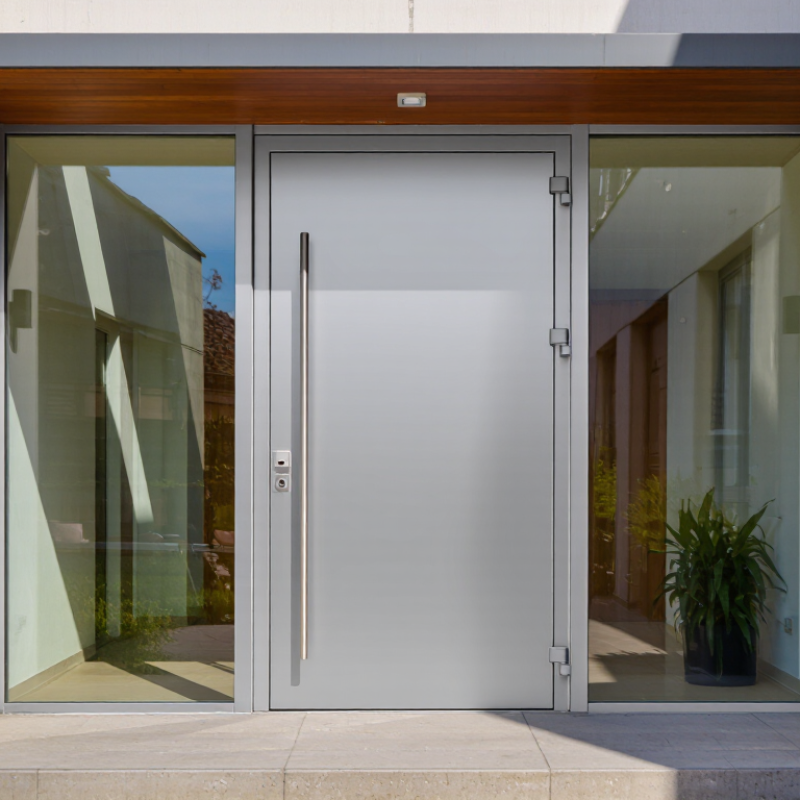
What Defines an Aluminum Entry Door?
Why Choose an Aluminum Entry Door?
What Defines an Aluminum Entry Door?
An aluminum entry door is more than a metal slab. It combines aluminum profiles, insulated panels, hinges, seals, glazing, and a tested locking system. Aluminum provides a strong frame with relatively low weight. It also resists rot, termites, and moisture damage. That matters around a wet porch or a busy family entrance.
The frame design defines performance. Modern systems often use thermal breaks, which separate interior and exterior aluminum surfaces. Without them, heat can move quickly through the frame. The U.S. Department of Energy evaluates doors through U-factor and air-leakage performance, not appearance alone. The National Fenestration Rating Council also requires certified products to report whole-unit performance. Check the complete assembly, not just the panel.
The International Energy Agency reported that buildings used about 30% of global final energy in 2022. A poorly sealed entrance can add drafts, noise, and unwanted heat transfer. A properly engineered aluminum door can reduce those weaknesses. Look for continuous weatherstripping, insulated cores, durable coatings, and accurate installation. Small gaps can become obvious on a windy evening.
Aluminum is not automatically the warmest choice. An inexpensive frame may conduct heat efficiently, despite its attractive finish. It can also feel cold when touched. That is the part many product descriptions overlook. Ask for verified U-factor data, air-leakage results, and coating specifications before deciding. Airtight installation still matters.
Why Choose an Aluminum Entry Door? — What Defines an Aluminum Entry Door?
| Dimension | What Defines an Aluminum Entry Door | Potential Advantage | What to Check |
|---|---|---|---|
| Frame and panel material | The door frame and, in many designs, the door panels are made primarily from aluminum. | Aluminum has a high strength-to-weight ratio, allowing relatively slim profiles and large glazed areas in suitable designs. | Construction varies. Confirm whether the slab, frame, or both are aluminum, and review the stated thickness and reinforcement. |
| Corrosion resistance | Aluminum naturally forms a thin oxide layer when exposed to air, which helps protect the underlying metal. | It does not rust in the same way iron or ordinary steel does and can be suitable for many exterior settings. | Coatings, cut edges, fasteners, and contact with dissimilar metals affect long-term performance. Follow the manufacturer’s care instructions. |
| Thermal performance | Aluminum conducts heat readily, so thermal performance depends substantially on the door’s design and components. | A thermally broken frame, insulated panel, glazing, and effective seals can help reduce heat transfer and drafts. | Compare tested whole-door performance ratings where available. Do not judge insulation from the frame material alone. |
| Finish and appearance | Common finishes include powder coating and anodizing, with colors and surface styles varying by product. | A range of finishes can support modern, minimalist, or custom exterior designs. | Check the finish specification, color options, cleaning guidance, and warranty coverage for fading or coating defects. |
| Maintenance | Aluminum doors generally need routine cleaning and inspection of moving parts, seals, and hardware. | The metal itself typically does not require painting to prevent rust, although finishes may need care over time. | Inspect weatherstripping, hinges, locks, drainage paths, and the surface finish periodically. |
| Security | Security depends on the complete door system, including the slab, frame, lock, hinges, glazing, and installation. | A well-designed aluminum system can be paired with multi-point locking and reinforced components. | Look for tested security information and suitable hardware; aluminum construction alone does not guarantee a security level. |
| Design flexibility | Aluminum can be formed into a variety of frame profiles and used with solid panels or glazing. | It can accommodate contemporary designs and larger glass openings, subject to the product’s structural limits. | For glazed doors, check glass type, safety requirements, privacy, and the door’s energy-performance details. |
| Environmental considerations | Aluminum is recyclable, and it can be recycled repeatedly when collected and processed appropriately. | Recycled content and end-of-life recycling may contribute to a project’s material-efficiency goals. | Environmental impact depends on production, recycled content, transport, service life, and local recycling options. |
| Cost and value | Price varies with dimensions, finish, thermal breaks, glazing, hardware, customization, and installation. | A suitable system may offer a balance of durability, design flexibility, and relatively low routine maintenance. | Compare complete quotes and specifications, including installation, warranties, energy performance, and future maintenance. |
Note: Performance varies by product and installation. Review the specific door’s tested ratings and technical documentation before purchase.
FAQS
It combines a frame, insulated panels, seals, hinges, glazing, and a locking system. The complete assembly affects comfort and performance.
Thermal breaks reduce heat transfer through the frame. Insulated cores, tight seals, and careful installation also matter. Aluminum alone is not insulation.
Ask for whole-door U-factor and air-leakage results. Check water and wind performance, too. A polished finish tells only part of the story.
In strong sun, dark finishes can become warm. Coastal salt may damage exposed areas, while cold weather can reveal weak seals. Details matter.
Options may include slim frames, textured finishes, larger glass areas, and multipoint locks. Reinforced hinges and securely anchored frames also help.
Not quite. Rinse coastal grime, clean with mild soap, and inspect seals, screws, and locks each year. Small checks help.
No. An uneven opening can cause rubbing, noise, and unreliable locking. Accurate leveling and installation matter as much as the door itself.
Conclusion
An Aluminum Entry Door is a durable, modern entrance system made primarily from lightweight aluminum components, often combined with insulated cores, protective coatings, and weather-resistant hardware. Its construction can be tailored for strength, energy efficiency, and long-term stability, while aluminum’s resistance to rust, warping, and moisture makes it suitable for many climates. With properly fitted seals and thermal breaks, these doors can help reduce drafts and improve indoor comfort throughout changing seasons.
Homeowners can choose from a wide range of colors, finishes, glass styles, panel designs, locks, and hinges to match both traditional and contemporary architecture. Security can be enhanced through reinforced frames, multi-point locking systems, and impact-resistant glazing. Maintenance is generally simple, requiring routine cleaning, inspection of seals, and occasional hardware adjustments. An Aluminum Entry Door is especially suitable when a property owner wants a strong, low-maintenance, customizable entrance that offers dependable performance without the upkeep commonly associated with wood.