Technical Whitepaper
Engineering Standards & Metallurgy of Architectural Aluminum Doors
In modern residential architecture, entrance doors represent far more than functional barrier points; they serve as critical building envelope components governing thermal isolation, structural resilience, acoustic barrier performance, and security integrity. As leading OEM/ODM aluminum residential door manufacturers and exporters, Foshan Aludex Doors & Windows Co., Ltd. provides comprehensive engineering insights into the alloy chemistry, structural mechanics, and thermal barrier technologies defining premium grade entrance solutions.
1. Metallurgy & Profile Physics: 6063-T5 vs. 6061-T6 Extrusions
The fundamental structural integrity of an exterior aluminum door relies entirely on alloy composition and temper state. We primarily specify 6063-T5 architectural grade aluminum alloy for our extruded door frames and panel sash profiles. Containing balanced ratios of Magnesium (0.45–0.9%) and Silicon (0.2–0.6%), 6063-T5 delivers an ideal equilibrium between tensile strength (yield strength ≥ 170 MPa) and superior surface smoothability required for high-end anodizing and fluorocarbon powder coating.
For oversized residential entrance pivot doors exceeding 3,000mm in height, structural sashes incorporate reinforced wall thicknesses ranging from 2.0mm to 3.5mm. Internal corner joints feature heavy-duty cast aluminum cleats secured via double pin crimping and two-component structural epoxy adhesives. This ensures zero frame distortion under wind pressure loads up to 5,000 Pa (equivalent to Category 5 hurricane pressures under ASTM E330 testing standards).
Information Gain Insight: Unlike standard hollow extrusions used in commodity doors, Aludex architectural profiles incorporate multi-chamber structural webs and localized internal ribbing. This engineering detail improves torsional stiffness by 38% compared to single-wall profiles, allowing large-format pivot door sashes to hold deadweight loads up to 500kg without hinge sag or seal compression failure.
2. Thermal Barrier Technology: PA66-GF25 Polyamide Strips
To combat heat transmission and fulfill strict building energy codes such as Title 24 in North America or EN ISO 10077 in Europe, modern aluminum doors require thermal break insulation. Aluminum has an inherent thermal conductivity of approximately 200 W/m·K. To isolate indoor and outdoor thermal zones, our thermally broken doors insert a PA66-GF25 (Polyamide 66 reinforced with 25% structural glass fiber) thermal barrier strip between exterior and interior profile sections.
The inclusion of 25% glass fiber matches the coefficient of thermal expansion of aluminum profiles (2.3 × 10⁻⁵ /K), preventing shear bond separation during extreme ambient temperature fluctuations ranging from -40°C to +80°C. Combined with polyurethane foam insulating core infills and triple EPDM weather-stripping gaskets, our thermal break entrance door assemblies achieve overall thermal transmittance coefficients (U-Factor) down to 1.4 W/m²·K (R-Value ~4.0).
3. Surface Finishing & Corrosion Resistance Protocols
Exterior entrance doors installed in coastal or high-humidity regions face harsh atmospheric corrosion. We execute a rigorous 7-stage chemical pre-treatment process—including degreasing, acid etching, and chromate-free conversion coating—prior to surface finish application. B2B clients can choose from three primary finishing options:
PVDF Fluorocarbon Coating
3-coat/2-bake Kynar 500® resin system meeting AAMA 2605 specifications. Offers 25+ years of resistance against UV fading, acid rain, and salt spray exposure (3,000+ hours ASTM B117 salt spray certified).
Thermosetting Powder Coating
Qualicoat Class 2 certified architectural powder coatings. Provides superior scratch resistance, high impact durability, and extensive matte, metallic, or textured color options for modern residential facades.
Sublimation Wood Grain Transfer
Combines the warm natural aesthetic of natural timber (Oak, Walnut, Teak) with zero wood maintenance. Resists termite damage, moisture warping, and rot in tropical or humid climates.
1. Oversized Pivot Systems
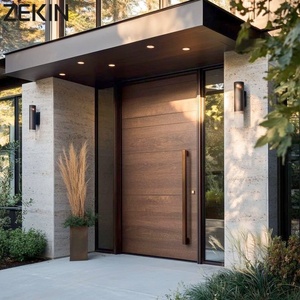
Architectural demand for grand entrances has led to a 45% increase in requests for pivot doors exceeding 1,500mm width and 3,500mm height. Sourcing focuses on heavy-duty hydraulic floor pivots with adjustable closing speed and hold-open functionality.
2. Crittall-Style Heritage Slim Framed Doors
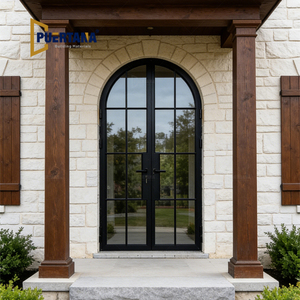
Combining industrial steel aesthetics with lightweight, non-rusting thermally broken aluminum profiles. Sidelights, transoms, and applied glazing bars create minimalist, light-filled entryways while meeting modern insulation codes.
3. Smart Access & Biometric Hardware Integration
Trade buyers increasingly demand factory-prewired door leaves capable of housing concealed smart locks, 3D facial recognition, semiconductor fingerprint sensors, and motorized multi-point latches synced to smart home automation networks.
4. Net-Zero Carbon & Circularity Compliance
With global green building certifications (LEED, BREEAM) gaining traction, international importers prioritize manufacturers utilizing low-carbon primary aluminum billets and 100% recyclable extrusion alloys with environmental product declarations (EPD).
5. High STC Sound Isolation Demand
Urban residential projects require effective acoustic dampening against street traffic noise. Current procurement mandates sound transmission class (STC) ratings between 38 dB and 45 dB, achieved through laminated glass and multi-chambered gaskets.
Manufacturer Competence
Foshan Aludex OEM/ODM Production Capabilities & Quality Control
Located in Foshan, Guangdong—the epicenter of China's structural aluminum industry—Foshan Aludex Doors & Windows Co., Ltd. operates a modern 30,000 m² manufacturing facility supported by over 300 experienced engineers and technical staff. Operating since 2004, our production ecosystem spans raw alloy extrusion, precision CNC machining, surface finishing, and custom door panel assembly.
Automated Extrusion Lines
Operating 8 hydraulic profile extrusion presses with capacities up to 2,500 metric tons, producing high-density 6063-T5 profile sections tailored to custom architect drawings.
5-Axis CNC Precision Engineering
High-precision CNC routing centers cut lock mortises, hinge pockets, drainage channels, and decorative panel carvings within tighter tolerances than ±0.1mm.
In-House QA / QC Testing Lab
Every production run undergoes strict quality control: cross-hatch adhesion testing, coating thickness measurement (Elcometer), corner break load testing, and air/water infiltration verification.
We provide full OEM and ODM cooperation models for global brand owners, trade wholesalers, building material stocking distributors, and real estate project developers. From technical CAD shop drawing validation to localized private-label packaging and custom hardware integration (including German Hoppe, Siegenia, GU, and custom smart lock systems), Aludex ensures your product line strictly matches regional building market expectations.
Q
What protection measures ensure doors arrive without scratches or structural deformation during ocean freight?
Every custom aluminum door leaf and frame undergoes a multi-layer export packaging protocol. First, profiles are wrapped in protective PE anti-scratch film and corner-protected with high-density EPE foam blocks. The entire assembly is then sealed in heavy-duty shrink wrap and encased inside custom-built fumigated plywood crates or rigid steel-framed stillages. In the unlikely event of transit damage, taking unboxing photographs and video within 48 hours allows our insurance team to initiate immediate component replacement or reproduction.
Q
Can trade buyers order physical material samples and color swatches before placing container-load contracts?
Yes. We encourage quality verification prior to mass production. We supply sample kits containing extruded profile cross-sections (demonstrating PA66 thermal breaks, wall thickness, and gasket seats), hardware samples, and powder coating or wood-grain finish aluminum chips. Standard sample boxes are prepared within 1 to 4 business days, shipped directly via express air courier (DHL/FedEx/UPS).
Q
What technical installation documentation and field support do you provide for local installers?
Every order includes CAD installation assembly drawings, anchor placement diagrams, and step-by-step PDF manual guides tailored to the project's sub-frame conditions (concrete, timber stud, or steel structure). Furthermore, we provide detailed video tutorials covering sub-frame leveling, pivot hinge zero-position adjustment, and multi-point lock alignment. Our engineering department also offers live video call guidance for contractor site teams.
Q
What are your standard manufacturing lead times and ocean shipping timelines?
Standard profile door orders require approximately 20 to 30 days for extrusion, surface finishing, CNC machining, and quality inspection. Fully customized bespoke architectural doors or non-standard powder-coat colors typically take 30 to 45 working days. Ocean freight transport from Foshan/Shenzhen ports ranges between 14 to 25 days to North America and Europe, 10 to 15 days to Australia, and 25 to 35 days to South America or Africa.
Q
Do you support full OEM private-label production and custom hardware integration?
Absolutely. As a dedicated OEM/ODM manufacturer, we offer full private-label customization, including custom branding on protective films, stamped aluminum logos, branded cardboard packaging, and custom user manuals. Additionally, if your market requires specific lock brands (e.g., Yale, Hoppe, Schlage, Baldwin, or specialized smart lock mortises), our CNC machines route the sash profile according to your exact lock template dimensions.
Q
What critical opening parameters and engineering data are needed to request a formal quotation?
To prepare accurate shop drawings and bill-of-materials pricing, please provide: (1) Rough opening dimensions (Width × Height × Wall Depth), (2) Opening configuration (Single leaf, Double leaf, Pivot, Sidelight/Transom inclusions), (3) Thermal break requirement, (4) Glass specifications (Double/Triple glazed, Low-E, Tinted, Laminated), (5) Preferred finish color, and (6) Destination sea port for freight calculation.