Comprehensive Industry Whitepaper: B2B Sourcing of OEM/ODM Villa Entrance Doors
1. The Architectural Shift in Villa Entrance Hardware
Over the past decade, residential architectural preferences have transitioned decisively toward grand-scale, open-concept, modern facades. Entrance openings that once measured standard 900mm x 2100mm dimensions now frequently exceed 1800mm in width and 3500mm in height. Traditional timber construction in these oversized configurations faces severe structural vulnerabilities: moisture absorption leads to swell, warp, and thermal bowing, which compromises perimeter weatherstripping and causes lock misalignment.
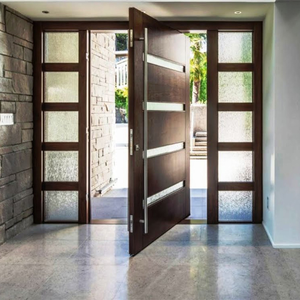
To overcome structural deflection in grand openings, leading architectural hardware specifiers specify 6063-T5 aluminum extrusions combined with steel frame reinforcement or heavy-duty cast aluminum armor panels. Aluminum provides an exceptional strength-to-weight ratio, enabling single-leaf pivot doors to span widths up to 2.5 meters and weights exceeding 400 kg while maintaining single-finger rotation via floor-spring axis systems.
2. Material Science: Engineering Specifications of 6063-T5 Alloys
The primary baseline for premium entrance door manufacturing at our Foshan facility is the selection of primary billet aluminum. Unlike recycled scrap aluminum which contains uncontrolled iron and silicon impurities leading to intergranular corrosion and brittle fracture, architectural-grade 6063-T5 alloy undergoes controlled artificial aging to achieve optimal mechanical properties:
- Tensile Strength (Ultimate): ≥ 185 MPa (ensuring resistance to high dynamic wind loads).
- Yield Strength (0.2% Proof Stress): ≥ 145 MPa (preventing permanent frame distortion).
- Webster Hardness: ≥ 12 HW (providing superior scratch resistance and structural rigidity).
- Elongation Rate: ≥ 8% (allowing precise CNC machining and structural bending without microscopic cracking).
For exterior finish stability, profiles undergo automated pre-treatment chromating followed by electrostatically applied PVDF (Polyvinylidene Fluoride) fluorocarbon coatings or architectural powder coatings (AKZO NOBEL / PPG). This chemical surface treatment guarantees over 20 years of fade resistance, salt spray resistance (> 3000 hours ASTM B117), and resistance to severe ultraviolet radiation in desert or tropical coastal regions.
3. Thermal Break Engineering: Mitigating Thermal Bridging
For luxury villa projects situated in extreme climatic zones—ranging from Nordic winter sub-zero temperatures to Middle Eastern extreme heat—uninsulated metallic frames act as thermal bridges. Cold bridging causes interior condensation, wall mold formation, and substantial HVAC energy loss.
Aludex solves thermal bridge transmission through our D100 & T93 Multi-Chamber Thermal Break Systems:
- Polyamide PA66 GF25 Insulation Strips: Structural thermal break barriers engineered with 25% glass fiber reinforcement match the thermal expansion coefficient of aluminum, preventing joint shear under extreme temperature differentials.
- Multi-Cavity Insulation Infill: Frame interior chambers are pressure-injected with high-density expanded polyurethane (PU) or aerogel insulation foam, dropping total frame U-values down to ≤ 1.2 W/m²K.
- Triple EPDM Weather Seal Gaskets: Continuous co-extruded EPDM rubber gaskets create three distinct air-tight and water-tight sealing lines around the perimeter of the door leaf, achieving Class 4 Air Permeability (EN 12207) and Class E1050 Watertightness (EN 12208).
4. The OEM/ODM Sourcing Workflow for Global Importers
Executing custom entry door projects requires an integrated engineering pipeline to ensure that factory fabrication perfectly aligns with job-site masonry rough openings. The standard procurement framework follows five controlled stages:
Step 2: Mock-up Sample Approval — Color swatches, profile cut-aways, and hardware samples (handles, mortise locksets) are dispatched for architect sign-off within 1 to 4 days.
Step 3: Precision Manufacturing — Computer Numerical Control (CNC) double-head cutting saws cut profiles to 0.1mm tolerance. High-speed CNC routers machine lock pockets, hinge mortises, and drain slots.
Step 4: Quality Control & Pre-Assembly — Every door leaf is hung in a test rig frame to verify squareness, latching force (< 20 N), smart lock communication, and smooth pivot rotational damping.
Step 5: Export Packing — Components are wrapped in protective PE film, corner-guarded with high-density EPE foam, and sealed inside fully enclosed fumigated plywood crates for safe sea container transport.
5. Hardware Engineering: Pivot Hinges, Multi-Point Mortise & Smart Access
The operational longevity of a villa entrance door depends heavily on its load-bearing hardware. Standard butt hinges are structurally insufficient for heavy architectural doors. Aludex integrates advanced heavy-duty structural hardware:
- Offset Floor Springs & Hydraulic Pivot Axes: Engineered to support single door leaf weights up to 500 kg. Features built-in 90-degree hold-open mechanisms, adjustable dual-speed closing controls, and anti-sag vertical axis alignment (+/- 5mm adjustment post-installation).
- Multi-Point Automatic Locking Sets: Stainless steel 304 multi-point lock bodies utilize top, middle, and bottom hook bolts that automatically engage upon closure, resisting anti-pry force up to 10,000 N.
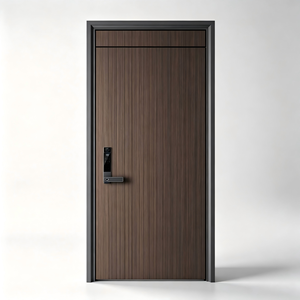
- Biometric & IoT Access Integration: Handles with integrated smart locking modules (T05/T6 series) seamlessly combine 3D semiconductor fingerprint scanning, encrypted RFID IC cards, mechanical emergency override keys, and Tuya/Zigbee smart home network protocols.
Material Performance Comparison Matrix
Technical performance evaluation for architectural material selection in villa entrance applications:
| Performance Parameter | 6063-T5 Thermal Break Aluminum | Cast Aluminum Armored Panel | Solid Hardwood (Teak/Oak) | Forged Wrought Iron |
|---|---|---|---|---|
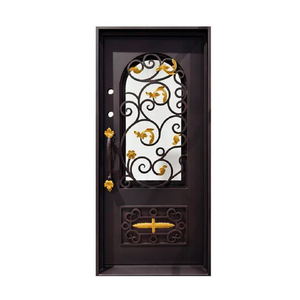
| Weather & Corrosion Resistance | Excellent (PVDF/Anodized > 20 Yrs) | Outstanding (No Rust/Rot) | Poor (Requires Annual Sealing) | Moderate (Prone to Rust if Scratched) |
| Dimensional Moisture Stability | 100% Stable (Zero Expansion) | 100% Stable (Zero Expansion) | Poor (Swells/Warps up to 5%) | 100% Stable |
| Structural Max Dimensions | Up to 3000mm x 6000mm | Up to 2500mm x 5000mm | Limited (< 1200mm x 2400mm) | Up to 2200mm x 4000mm |
| Thermal Conductivity (U-Value) | Low (1.2 - 1.8 W/m²K) | Low (1.4 - 2.0 W/m²K) | Medium (1.8 - 2.5 W/m²K) | Very High (> 5.0 W/m²K) |
| Maintenance Requirement | Zero Maintenance (Wipe Clean) | Zero Maintenance | High (Re-varnish every 2 yrs) | Moderate (Rust touch-ups) |
| Smart Lock Integration | Fully Concealed / Integrated | Integrated Armored Pockets | Surface Mortised | External Rim Mounted |
6. Future Purchasing Trends: Villa Entrances (2025–2030)
As residential design continues to evolve, global procurement officers should align their supply chains with three dominant architectural purchasing trends:
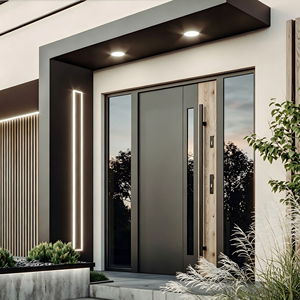
A. Seamless Flush Facade Integration: Modern minimalist architectural designs demand zero-frame sightlines. Sourcing trends prioritize hidden frame pivot doors where the exterior aluminum door panel sits flush with exterior stone cladding or curtain wall glazing systems.
B. Ultra-High Security Armored Core Hybrids: Buyers increasingly request hybrid construction: high-strength structural aluminum exterior face plates for weather protection, combined with internal bullet-resistant steel armor cores and decorative interior wood veneer paneling matching interior joinery.
C. Automated Powered Pivot Systems: High-net-worth villa projects are adopting fully automated motorized swing and pivot operators. Integrated radar motion sensors and smart home access control trigger linear actuators to open massive entrance panels automatically.