0%

Choosing the right Aluminum Entrance Door is a performance decision, not merely a design preference. Global buyers must compare climate, security, energy use, installation quality, and long-term maintenance. A door that performs well in Dubai may require different glazing and seals in Stockholm.

Industry evidence supports careful specification. The U.S. Department of Energy explains that low-emissivity glazing and thermally improved frames can reduce unwanted heat transfer. The Aluminum Association also highlights aluminum’s durability, corrosion resistance, and strong recycling value. Meanwhile, international fenestration standards, including EN 12207 for air permeability and EN 12208 for watertightness, provide useful testing references. However, compliance marks alone do not guarantee a successful installation.

Details matter.

This guide reviews seven leading Aluminum Entrance Door options for residential, commercial, and hospitality projects. Each selection considers frame construction, thermal breaks, glazing compatibility, locking systems, weather seals, finish quality, and supplier support. Picture a coastal entrance exposed to salt spray, or a hotel doorway handling thousands of daily openings. The specifications must match the location.

Published market reports can reveal broad growth trends, but they rarely explain real installation problems. They may not show warped thresholds, poorly adjusted hinges, or delayed replacement hardware. That gap deserves attention. Our comparison therefore balances reported industry knowledge with practical buying considerations, including lead times, customization, warranty clarity, and after-sales service. No single door wins everywhere. The best choice depends on measurable performance, local conditions, and the supplier’s ability to deliver consistently.
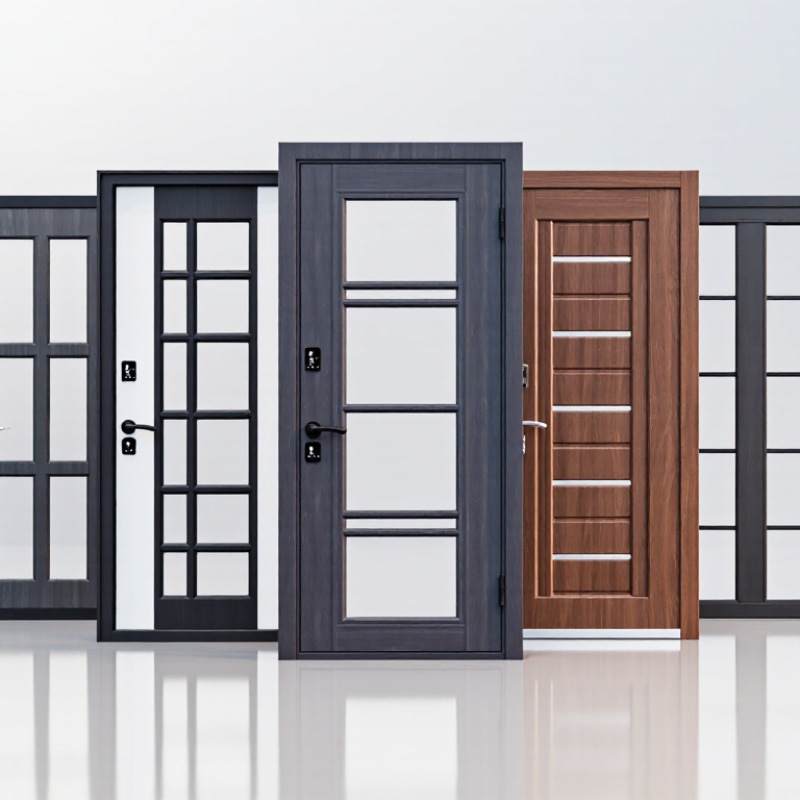
7 Best Aluminum Entrance Doors for Global Buyers

Seven Aluminum Entrance Door Types Ranked by U-Value, Security, and Durability

7 Best Aluminum Entrance Doors for Global Buyers

Ranked by U-value, security, and durability, thermally broken aluminum doors lead the list. Rank 1 is a triple-glazed passive-house style door, typically reaching 0.7–1.0 W/m²K. Rank 2 is a double-glazed thermal-break door, usually around 1.1–1.6 W/m²K. Rank 3 is an insulated aluminum-panel door, often near 1.0–1.5 W/m²K. These figures are indicative, not guaranteed. The NFRC 100 standard measures whole-product U-factor, including frames and glazing, not glass alone. Installation can change the result.

Rank 1 is a triple-glazed passive-house style door, typically reaching 0.7–1.0 W/m²K.
Rank 2 is a double-glazed thermal-break door, usually around 1.1–1.6 W/m²K.
Rank 3 is an insulated aluminum-panel door, often near 1.0–1.5 W/m²K.

These figures are indicative, not guaranteed. The NFRC 100 standard measures whole-product U-factor, including frames and glazing, not glass alone. Installation can change the result.

Rank 4 is a multi-point glazed door, offering strong resistance when tested under EN 1627 security classes.
Rank 5 is a reinforced pivot door, valued for wider openings and rigid hardware.
Rank 6 is a standard non-thermal-break aluminum door, commonly above 2.0 W/m²K.
Rank 7 is a louvered or perforated aluminum door, useful for ventilation but weaker thermally.

Cold bridges remain a concern. The U.S. Department of Energy’s Building America research identifies continuous insulation and thermal breaks as practical methods for reducing heat transfer.

For durability, look for powder-coated finishes, stainless-steel fasteners, adjustable hinges, and replaceable seals. ASTM E330 evaluates structural performance under wind pressure, while AAMA testing examines water penetration and operational behavior.

Security depends on the complete assembly: cylinder, lock case, hinges, frame anchoring, and laminated glass. A premium U-value cannot repair a poorly anchored frame. Real projects still expose this weakness.

Thermal Performance: Comparing U-Values from 0.8 to 2.0 W/m²·K

7 Best Aluminum Entrance Doors for Global Buyers

Thermal Performance: Comparing U-Values from 0.8 to 2.0 W/m²·K

For global buyers, U-value is a practical starting point when comparing aluminum entrance doors. It measures heat transfer through the complete door assembly. Lower values usually mean better insulation. A door rated at 0.8 W/m²·K can reduce heat loss more effectively than one rated at 2.0 W/m²·K. This difference matters in cold regions, heated hallways, and buildings with large temperature changes.

However, the quoted figure needs careful checking. Some suppliers report the door panel only, while others test the entire installed unit. The frame, glass, seals, threshold, and thermal breaks can change real performance. Ask for laboratory test results and the exact testing standard. A strong thermal break should separate the inner and outer aluminum sections. Well-fitted seals should compress evenly around the perimeter.

Installation remains critical. Even an excellent 0.8 U-value can perform poorly beside an uninsulated wall opening. I have seen drafts caused by small gaps near thresholds and hinges. These details are easy to overlook. In warmer climates, a 1.2 to 1.6 U-value may provide a practical balance between insulation, cost, and ventilation needs. In colder climates, buyers may prefer values near 0.8, especially with triple glazing. Yet the lowest number is not automatically the best choice. Moisture control, solar exposure, hardware quality, and local building requirements deserve equal attention.

7 Best Aluminum Entrance Doors for Global Buyers

Thermal Performance: Comparing U-Values from 0.8 to 2.0 W/m²·K

The chart compares representative whole-door U-values for seven commonly specified aluminum entrance-door configurations. Lower U-values indicate better thermal insulation. Actual performance may vary according to door size, glazing, frame design, spacer systems, seals, and certified test standards.

Frame Strength, Corrosion Resistance, and Aluminum Alloy Grades

When choosing aluminum entrance doors for global projects, frame strength deserves more than a thick profile. I inspect corner joints, hinge reinforcement, wall anchors, and drainage paths. A strong frame can still fail when fasteners loosen or the opening is poorly supported. Large doors need accurate structural calculations, especially in coastal regions or high-wind areas.

Aluminum alloy grade affects performance, but it is not the only decision. 6063 is commonly selected for clean extrusions and attractive surface finishes. 6061 and 6005A can offer higher structural strength for reinforced frames. Temper matters too. T5 and T6 conditions may change hardness, machining behavior, and load performance. Ask for mill certificates and tested mechanical data, not only a catalog description.

Corrosion resistance requires practical detailing. Anodizing can create a durable oxide layer, while powder coating adds color and another protective barrier. Yet damaged edges, trapped water, and incompatible metal contacts can still cause staining or galvanic corrosion. I once saw a well-finished frame deteriorate because its drainage holes were blocked by sealant. Small details matter. I would also check coating thickness, adhesion tests, gasket compatibility, and maintenance access before approving a door. The alloy label alone cannot predict service life.

Global Standards: EN 14351-1, ASTM E283, and ISO 10077 Requirements

Choosing among the 7 best aluminum entrance doors for global buyers requires more than attractive profiles. The correct choice may be a thermally broken single door, double-leaf door, glazed door, pivot door, insulated-panel door, low-threshold door, or high-security entrance system. EN 14351-1 evaluates external pedestrian doorsets through declared performance characteristics, including air permeability, watertightness, wind resistance, and thermal transmittance. It does not replace every local safety requirement.

ASTM E283 measures air leakage under controlled pressure differences. Lower leakage usually means fewer drafts around the frame. ISO 10077 calculates thermal transmittance for windows and doors, including frames and glazing. This matters because aluminum conducts heat quickly without a thermal break. The International Energy Agency reports that buildings consume roughly 30% of global final energy. Door performance is only one part, but weak entrances can undermine an efficient envelope. Field inspections often reveal a practical problem: a good U-value cannot correct poor installation, uneven thresholds, or compressed seals.

Tips: Ask for EN 14351-1 performance declarations, ASTM E283 test conditions, and ISO 10077 calculation boundaries. Compare U-values using the same reference area. Check air-leakage results at realistic pressure levels. Review drainage details and gasket compression. A door can pass laboratory testing yet perform poorly on site. That gap deserves honest attention.

7 Best Aluminum Entrance Doors for Global Buyers - Global Standards: EN 14351-1, ASTM E283, and ISO 10077 Requirements

Door Type Typical Construction Common Leaf Size Range Typical Uw Value
(W/m²·K)
EN 14351-1 Performance Considerations ASTM E283 Air Leakage Specification ISO 10077 Thermal Calculation Recommended Applications
Thermally Broken Insulated Panel Door Aluminum outer skins with a thermally separated frame, insulated core, compression seals, and adjustable hinges. Single leaf: approximately 900–1,200 mm wide × 2,100–2,400 mm high. 1.1–1.6 Suitable for tested classification of air permeability Class 3–4, water tightness 5A–7A, and wind resistance C3–C5, depending on the complete doorset. Specify and verify by testing; a common commercial project target is ≤0.06 cfm/ft² at 1.57 psf (75 Pa). Uw should be calculated for the complete frame, leaf, infill, edge zones, and glazing or panel interfaces using ISO 10077-1/-2 methods. Cold climates, apartment entrances, offices, schools, and high-traffic exterior openings.
Low-E Double-Glazed Aluminum Entrance Door Thermally broken aluminum frame with sealed insulating glass unit, low-emissivity coating, warm-edge spacer, and multipoint locking. Single leaf: approximately 850–1,100 mm wide × 2,100–2,400 mm high. 1.2–1.8 Performance depends strongly on glazing, gaskets, drainage, threshold, and installation. Test evidence should identify the full configuration under EN 14351-1. Use the same test pressure and specimen configuration specified for the project; leakage is reported in cfm/ft² or L/s·m², not assumed from frame material alone. Calculate the combined effect of frame Uf, glass Ug, spacer, edge linear transmittance, and panel dimensions. Residential buildings, hotels, commercial offices, and general energy-efficient entry applications.
Full-Height Glazed Thermally Broken Door Slim thermally broken aluminum profiles with large low-E insulating glass panels, safety glazing, perimeter seals, and reinforced hardware. Single leaf: approximately 900–1,200 mm wide × 2,200–3,000 mm high. 1.3–1.9 Glazing area increases the importance of water tightness, wind resistance, impact safety, and glass specification. EN 14351-1 test results apply only to the tested doorset. Air leakage must be tested with the selected glass, gaskets, hardware, and threshold installed; visual glass design does not guarantee airtightness. Uw is typically governed by the glass and frame ratio. ISO 10077 calculations should include the actual glazing dimensions and frame geometry. Retail stores, hotels, showrooms, office lobbies, and modern residential façades.
Double-Leaf Aluminum Entrance Door Two coordinated thermally broken leaves with an astragal or meeting stile, concealed or surface closers, and adjustable sealing system. Total opening: approximately 1,600–2,400 mm wide × 2,100–2,700 mm high. 1.4–2.0 Meeting-stile alignment, rebated joints, thresholds, and locking points are critical to achieving air, water, and wind classifications under EN 14351-1. Test the complete double-leaf assembly, including inactive-leaf bolts and meeting-stile seals. A project target such as ≤0.06 cfm/ft² at 75 Pa must be contractually defined and verified. Calculate the complete doorset, including both leaves, frame sections, meeting stile, glazing or infill, and thermal bridges at the threshold. Building entrances, public facilities, schools, hospitals, and openings requiring wider pedestrian access.
Heavy-Duty Commercial Aluminum Door Reinforced thermally broken profiles, thicker aluminum sections, stainless-steel or high-cycle hardware, laminated or insulating safety glass, and robust thresholds. Single leaf: approximately 900–1,250 mm wide × 2,100–2,500 mm high. 1.5–2.2 Choose tested hardware and hinges for the door mass and operating frequency. EN 14351-1 documentation should cover durability, weather performance, and safety-related characteristics where applicable. Air leakage should be tested after hardware adjustment and under the specified pressure sequence. Heavy-duty construction alone is not an ASTM E283 result. ISO 10077 calculations should account for reinforced frame sections, metal edge zones, glass spacers, and threshold thermal bridges. Shopping centers, transport buildings, healthcare facilities, factories, and busy public entrances.
Aluminum Pivot Entrance Door Thermally broken aluminum frame with concealed top-and-bottom pivot hardware, oversized leaf options, continuous seals, and insulated panel or low-E glass. Single leaf: approximately 1,000–1,500 mm wide × 2,200–3,200 mm high. 1.5–2.4 Oversized leaves and pivot clearances can affect air permeability and water tightness. The complete pivot doorset should be tested in the intended configuration. Verify leakage with the actual pivot hardware, seals, threshold, and operating position required by the project test procedure. Use the actual pivot frame profiles, panel build-up, glass, and edge details in the ISO 10077 calculation; large leaves may increase frame and edge losses. Luxury residences, hotels, galleries, corporate entrances, and architectural feature façades.
Fire- and Smoke-Control Aluminum-Framed Entrance Door Specially engineered aluminum framing system with approved fire-resistant glazing or infill, intumescent seals, self-closing hardware, and compatible threshold details. Single or double leaf: commonly 800–2,400 mm total width × 2,000–2,500 mm height. 1.8–3.0 Fire resistance and smoke control are separate regulated properties and require the applicable local test and classification. EN 14351-1 weather performance does not replace fire testing. ASTM E283 air leakage testing may be specified for the external doorset, but it does not certify fire or smoke performance. Thermal values must use the tested or approved fire-rated glass, infill, frame, seals, and edge details; ordinary glazing calculations are not interchangeable. Exit routes, stair cores, institutional buildings, commercial complexes, and projects with compartmentation requirements.
Technical note: EN 14351-1 establishes product characteristics and conformity requirements for external pedestrian doorsets; it does not assign one universal performance value to every aluminum door. ASTM E283 is an air-leakage test method, so the allowable leakage rate must be defined by the project specification. ISO 10077-1 and ISO 10077-2 provide calculation procedures for thermal transmittance and should be applied to the complete doorset. Final values require testing or calculation for the exact frame, glazing or panel, hardware, seals, threshold, size, and installation condition.

Buyer Guide: Door Sizes, Glazing Options, Warranties, and Climate Ratings

Choosing among the 7 best aluminum entrance doors starts with accurate measurements. Record the finished wall opening, not only the old door panel. Allow space for shims, insulation, and threshold adjustment. Common sizes vary by region, so confirm millimeters or inches before ordering. A small measuring mistake can delay installation.

Glazing affects comfort, security, and energy use. Double glazing suits many temperate climates, while low-emissivity glass can reduce heat transfer. In hot regions, check the solar heat gain rating. In colder areas, review the U-factor and thermal-break design. Laminated glass improves impact resistance, while tempered glass breaks into smaller pieces. Clear glass brings daylight. Frosted glass offers privacy. A balanced choice matters.

Read the warranty line by line. Confirm coverage for frames, hardware, finishes, seals, and glass. Ask whether labor and replacement shipping are included. Coastal buyers should request corrosion-resistant finishes and drainage details. Wet climates need reliable sill protection. Cold climates need compression seals and insulated thresholds. Strong sun can fade a poor finish. Do not trust a broad “all-climate” claim without test data. Ratings may also depend on installation quality, which buyers often underestimate. Some specifications still feel incomplete, especially when regional testing methods differ. That deserves a careful question before payment.

FAQS

Which aluminum entrance door has the lowest U-value?

A triple-glazed, thermally broken door usually performs best. Its typical U-value ranges from 0.7 to 1.0 W/m²K. These figures are indicative. Installation can change the result.

Is a lower U-value always the better choice?

Not always. A low U-value does not guarantee strong security or durable hardware. A poorly anchored frame can still fail. Compare insulation, locks, hinges, glazing, and installation quality together.

How does a thermal break improve an aluminum door?

A thermal break interrupts the metal path through the frame. It reduces heat transfer and cold-bridge risk. Without one, standard aluminum doors often exceed 2.0 W/m²K. That can increase indoor heat loss.

What door type suits a wide entrance opening?

A reinforced pivot door can suit wider openings. Its rigid hardware helps manage the larger panel. However, structural calculations remain important. Wide doors can stress hinges, anchors, and surrounding walls.

Which details show that an aluminum door may last longer?

Look for powder-coated or anodized surfaces and stainless-steel fasteners. Adjustable hinges and replaceable seals also matter. Check drainage paths carefully. Blocked holes can trap water and damage an excellent finish.

Does the aluminum alloy grade determine frame durability?

Alloy grade matters, but it does not decide everything. Common structural choices include 6061, 6005A, and 6063 grades. Temper conditions can affect hardness and load performance. Request mill certificates and mechanical test data.

What should buyers check for security?

Check the complete assembly, not only the lock cylinder. Review the lock case, hinges, frame anchors, and laminated glass. Multi-point locking can improve resistance when properly tested. A strong lock cannot fix a weak frame.

How can buyers compare doors from different countries fairly?

Compare whole-door U-values using the same reference area. Review air leakage, water resistance, wind performance, and thermal data. Ask for test conditions and calculation boundaries. Laboratory results may not match a poorly installed door. That gap deserves attention.

Conclusion

This guide evaluates seven Aluminum Entrance Door types for global buyers, ranking them by thermal performance, security, and long-term durability. It compares U-values ranging from 0.8 to 2.0 W/m²·K, helping readers understand how frame design, insulation, glazing, and installation affect energy efficiency in different climates. The article also examines frame strength, corrosion resistance, and aluminum alloy grades, with attention to demanding residential and commercial applications.

To support informed purchasing decisions, the guide explains key international requirements, including EN 14351-1, ASTM E283, and ISO 10077, while highlighting the importance of verified testing and proper installation. Buyers will also find practical advice on standard and customized door sizes, glazing options, climate ratings, warranty coverage, and maintenance expectations. By balancing performance, safety, durability, and compliance, this overview helps purchasers select an entrance door suited to their project requirements and regional environmental conditions.

Ethan

Ethan

Ethan is a dedicated marketing professional with a deep understanding of the company’s products, customers, and industry landscape. Through thoughtful research and practical experience, he transforms complex product features into clear, useful insights that help readers make informed decisions.......